
Hancock Detention Release Paths
The Hancock County Public Safety Complex, also called the Hancock County Adult Detention Center, is operated by the Hancock County Sheriff's Office. A local detainee may leave into the community after a court or jail authorization. The record may identify bond, recognizance, dismissal, time served, probation, or sentence completion. Each term answers a different legal question. Bond and recognizance allow physical release while a case continues. Time served credits custody against an ordered term. Probation keeps the person in the community under court-imposed conditions.
Other departures are changes of custodian. A sentenced person may move into Mississippi Department of Corrections custody. Another agency may receive the person on a warrant or detainer, which is a request or authority to hold someone for that agency. The destination can also be another county, federal or immigration custody, a hospital, or another facility. Ask for the recorded release disposition and receiving agency. Those fields distinguish a true Hancock County community release from transport.
Confirm Hancock Detention Releases
The official HCSO inmate lookup embeds JailTracker and is designed around current custody. No verified public release archive, rolling release feed, update schedule, or retention promise was found. A person still listed may remain confined even if a release order is pending. A person no longer listed may have left the jail, transferred, or been affected by a data correction. Use the current roster only as the first check.
Follow the custody trail in order. This method avoids treating silence as release and preserves the legal source for the event.
- Search the official Hancock County roster with the correct name and known booking details.
- Call HCSO and ask whether physical release occurred, the date and time, the legal disposition, and any receiving agency.
- Check Mississippi VINE for an agency-supplied custody event, then confirm an alert with HCSO.
- Use the proper municipal, justice, or circuit court file for the order behind bond, dismissal, sentencing, or transfer.
- If MDOC, BOP, or ICE received custody, continue in that agency's locator instead of the county roster.
The broader Hancock County released-inmate search explains how the jail, court, state, federal, and notification records fit together. Note: A court order can precede actual departure because staff must complete administrative checks before the custody transaction closes.
Hancock Detention Records Contact
HCSO publishes no dedicated online form for a release record or booking photograph. A narrow written request should identify the person, approximate booking date, and booking number when known. Ask for the existing booking and release record, actual release date and time, disposition or authority, and destination or receiving agency if it was a transfer. A booking photo is a separate image record and should be requested separately. Ask for an electronic copy and a cost estimate before work begins.
Hancock County Sheriff's Office
Hancock County Public Safety Complex
8450 Highway 90
Bay St. Louis, MS 39520
Phone: 228-466-6900
Fax: 228-255-8246
Email: so2@co.hancock.ms.us
The sheriff FAQ lists general office hours as Monday through Friday, 8 a.m. to 5 p.m., and describes a $5 report fee. That statement was not verified as a fixed release-record or booking-photo charge. Mississippi public-records law permits actual-cost charges and reasonable procedures, so request an itemized estimate. If material is withheld, ask for the written statutory basis and release of nonexempt portions with protected fields redacted.
Hancock Detention Custody Types
The most important fact about the Hancock County complex is its mixed population. Local pretrial and sentenced detainees share the broader facility setting with people held under other legal authority. The official visitation information identifies MDOC prisoners in custody sections AA and AG. ICE inspection material also documents an immigration contract population. Physical location alone therefore does not establish who controls the release decision.
The official visitation screen shows why the legal custodian must be checked before interpreting a roster change.
View the HCSO source for facility visitation and MDOC custody context.
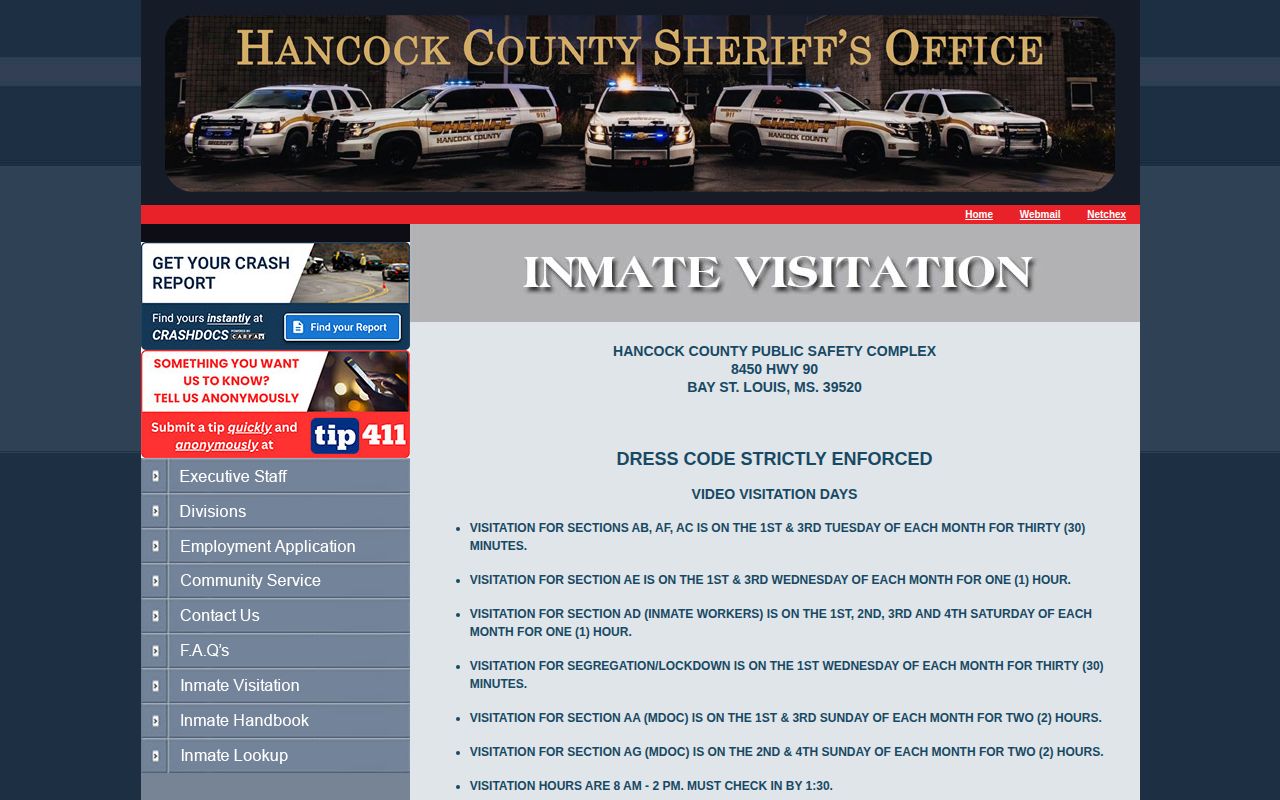
The captured page identifies the shared setting, while the release record identifies whether the person entered the community or another system.
| Population | Meaning of departure | Next verification source |
|---|---|---|
| County detainee | Community release or transfer | HCSO and court file |
| MDOC prisoner | State move, supervision, or later discharge | MDOC search and records |
| ICE detainee | Transport, immigration release, or other ICE action | HCSO receiving-agency field and ICE locator |
ICE Transfers from Hancock Detention
The Hancock complex has a documented ICE Enforcement and Removal Operations detention agreement. Federal audit and inspection reports describe immigration detainees held there while awaiting transport or another immigration action. An ICE population can be small, short-stay, or absent on a given inspection day. That makes a roster disappearance especially easy to misread. It may mark a transfer to the immigration detention network rather than release into Hancock County.
Ask HCSO whether ICE received custody and request the date, time, and destination recorded in the release or transfer transaction. Then use the ICE Online Detainee Locator. ODLS searches by A-number and country of birth, or by name, date of birth, and country of birth. Recent transfers and some case categories may not display at once. Immigration detention is civil custody, not a state or federal criminal sentence. A failed locator search does not convert the transaction into a community release.
Note: Only an affirmative agency record should be described as release into the community when a detainer or receiving agency is involved.
Hancock Detention Discharge Rule
The Hancock inmate handbook contains a local rule that uses discharge as an administrative event. A person formerly housed on misdemeanor charges may not return as a visitor for six months after discharge unless the Warden gives permission. The rule does not create a public release feed, but it shows that the facility records and acts on a distinct discharge date.
That visitation restriction should not be mistaken for a sentence, supervision term, or ban that applies outside visits to the jail. It is a facility access rule. Someone planning a visit after release should contact the Corrections Division about current permission and procedures. The handbook also says visitor information can include local transportation information, but it does not publish a release exit, pickup area, route, or promise of a ride. Those logistics must be confirmed directly rather than borrowed from another jail.
Hancock Detention Court Records
The court file explains the legal authority behind many Hancock County releases. Sheriff misdemeanors and felony preliminary matters generally begin in Justice Court. A Bay St. Louis or Waveland municipal case starts with the municipal court. A felony bound over or indicted proceeds in Circuit Court. Request the docket and the specific bond, dismissal, sentencing, probation, revocation, or time-served order. A disposition date may differ from the jail's physical departure time, so use both court and jail records when exact timing matters.
Justice Court is located at the same Highway 90 complex and handles criminal misdemeanors, felony preliminary hearings, and specified citations. The county says an initial appearance generally occurs within 48 hours after arrest. That is not a release deadline. It explains why a bond or detention order may appear early. For older events, the court file can remain useful after the current JailTracker card is gone.
- Release
- Departure into the community under legal authority.
- Transfer
- Movement from one custodian to another.
- Discharge
- The recorded end of a custody or supervision status, depending on the agency.
- Detainer
- Authority or a request for another agency to hold or receive a person.
These terms should be read from the record, not inferred from roster status. The Hancock County jail transaction answers physical custody, while the court order explains legal authority.
Hancock Bond Release Court Trail
The Circuit Clerk publishes a local bonded-out procedure that also matters at the Hancock County Adult Detention Center. If someone bonded out before an initial appearance or appointment of counsel, a petition may be obtained from the clerk in person or by mail. If the matter is later indicted, it then appears on the Circuit Court docket. That sequence can leave little early circuit information even though HCSO completed a real release.
Keep the booking number, arresting agency, and first court with the Hancock release transaction. Those identifiers connect an early jail exit to the later docket without treating sparse Circuit Court data as proof that no release occurred. The jail record establishes physical custody, while the filed court order explains the legal basis.