
How Hancock County Release Works
A Hancock County release is a change in legal or physical custody, but it does not always mean that a person went home. Someone may leave the Hancock County Public Safety Complex on bond, recognizance, time served, probation, dismissal, or sentence completion. Another person may leave the same building in the custody of the Mississippi Department of Corrections, another county, a federal agency, an immigration authority, a hospital, or a treatment placement. The release entry must be read with its type and destination.
The live Hancock County Sheriff inmate lookup is designed for present custody. Once a record drops from that view, the event may remain in an internal booking and release report, a court order, VINE data, or a receiving agency's system. A missing name is only a clue. It can also reflect a transfer, a spelling issue, an update delay, an expunged record, or a correction to the source data.
- Discharge
- The end of a custody or supervision status under the controlling authority.
- Time served
- Release because credited custody satisfies the ordered jail term.
- Parole
- Conditional release from incarceration granted by the Mississippi State Parole Board.
- Probation
- A court-ordered community sentence or suspended term, often supervised by MDOC.
- Transfer
- Movement to another custodian, not release into the community.
Hancock County Release Types
The legal basis matters as much as the date. Bond or recognizance ends physical detention while the case continues. A dismissal may end the charge that supported custody, although the docket supplies the precise result. Parole and earned release supervision put a person outside an institution while legal control continues. Transfers keep custody in place under a new agency.
| Release type | Meaning | Next record to check |
|---|---|---|
| Bond or recognizance | Physical release while the case remains open | Bond order and court docket |
| Time served or expired term | The credited local term has ended | Sentencing order and jail calculation |
| Dismissal | A charge or detention basis may have ended | Filed dismissal or docket entry |
| Probation | Community sentence ordered by a court | Court order and MDOC supervision office |
| Parole or ERS | Release from an institution with state jurisdiction continuing | MDOC record and Parole Board action |
| Transfer | Another agency or facility receives custody | Receiving agency locator or transfer sheet |
A death in custody may close a custody episode for an entirely different reason. It should never be presented as an ordinary release. If the record uses only a short code, request the legend or the full transaction from the agency that entered it.
Read Hancock County Release Records
A release record is not one fixed form. Hancock County may maintain a booking and release report, jail register entry, bond document, transfer sheet, or electronic custody event. The court holds the order that authorized a change. VINE may receive a notice event. State and federal systems use their own status and date fields. Ask for the narrow record that proves the fact at issue.
| Field | What it shows |
|---|---|
| Full name and identifier | Connects the event to the correct person |
| Booking number and time | Ties release back to a specific custody episode |
| Arresting agency | Identifies the first agency and likely court route |
| Release date and time | Records when the facility processed the custody exit |
| Release type or authority | Explains whether the basis was bond, court order, sentence end, or another event |
| Destination or receiving agency | Separates community release from transfer |
| Charge and case number | Links the jail event to the lasting court file |
| Bond type and amount | Shows the bond terms when that was the release basis |
A booking photograph is a separate image record, even when software displays it beside booking data. Ask for the photograph by name, booking number, and date. An online event time may also differ from the actual gate time because staff must act on the order, complete checks, return property, address transport, and update other systems.
Request Hancock County Release Records
The Hancock County Sheriff's Office is the direct source for a county jail transaction. A focused request reduces confusion and makes redaction easier. The office lists 8450 U.S. Highway 90, Bay St. Louis, MS 39520, telephone 228-466-6900, fax 228-255-8246, and email so2@co.hancock.ms.us. General office hours are Monday through Friday, 8 a.m. to 5 p.m. The published $5 statement concerns reports in general, not a verified fee for every release record or booking photo.
- Give the person's full name plus a booking date or booking number when known.
- Ask for the release date and time, release type or authority, and destination or receiving agency.
- Request the booking sheet and photograph separately if both are needed.
- Ask for the record in its existing electronic form and request a cost estimate before work begins.
- If the event involved state custody, submit the equivalent narrow request to MDOC Records through its official public-records channel.
The sheriff's official contact page should be checked before sending a request because hours, addresses, and staff contacts can change. Under Mississippi's Public Records Act, an agency may charge actual costs and redact exempt material. If part of a record is withheld, ask for the written statutory basis and the nonexempt portion.
A roster disappearance does not prove release. Ask for the affirmative release transaction and any named receiving agency.
Hancock Release Record Access
Mississippi Code Section 25-61-5 supplies the core access and response framework. Sections 25-61-3 and 25-61-7 define public records and allow reasonable procedures and actual-cost charges. The law supports a targeted request for an existing booking or release record, but it does not make every field public without limit.
Juvenile material, sealed or expunged cases, medical data, victim information, protected investigative matter, and security-sensitive jail details may be withheld or redacted. A public booking fact can sit beside an exempt field in the same record. Mississippi Code Sections 99-15-26 and 99-19-71 provide expungement routes for some outcomes and convictions. Eligibility is case-specific. A sealed result may explain why an old public entry is no longer visible, but silence still does not establish what happened.
Retention is another separate issue. No public promise was found that Hancock JailTracker preserves released entries for any fixed number of hours or days. The court case and a direct records request are more durable paths for an older event.
Trace Hancock Release Court Records
Hancock's arresting agency determines the first court trail. Sheriff's misdemeanors and felony preliminary matters begin in Justice Court. Bay St. Louis or Waveland police matters may begin in the corresponding municipal court. A felony that is bound over and indicted reaches Circuit Court. That local split explains why one countywide court search may miss an early or municipal record.
The Hancock County Circuit Clerk also publishes a process for someone who bonded out before an initial appearance or appointment of counsel. A petition may be obtained in person or by mail, and an indicted case then appears on the Circuit Court docket. Early circuit data can therefore be sparse even after a real release. Ask for the docket sheet and the exact bond, dismissal, sentencing, revocation, or satisfaction order.
Mississippi Electronic Courts may provide access for participating courts, subject to account rules, visibility, and fees. It is not a guaranteed free name search for every Hancock municipal or justice matter. The clerk remains the authoritative route when the electronic path does not show the case.
Find Hancock County Released Inmates
Start with the last known custodian, not a broad name search. The same name can appear in county, state, federal, and immigration systems, while each system covers a distinct custody authority. Match a booking number, MDOC ID, federal register number, date of birth, or other identifier before treating a result as the right person.
- Open the official HCSO roster if the last known stay was at the Hancock complex. Read a current result as current custody only.
- If state sentencing or an MDOC transfer is known, search MDOC by ID or full name and open the detailed record.
- Check the correct court for the order that explains bond, dismissal, sentencing, revocation, or transfer.
- Use Mississippi VINE as a notice and custody-event channel for a participating county or state agency.
- Use BOP for a federal prison sentence and ICE ODLS only for civil immigration detention.
- When no public result resolves the event, request the transaction from HCSO or the controlling agency.
Older Hancock County released inmates are less likely to remain on an operational jail interface. The court record and agency response become more important with time. For a date-range question, the Hancock jail releases for 24 hours page explains the same-day request method without claiming that a public feed exists.
Search Hancock MDOC Release Status
The MDOC inmate search accepts first name, last name, or MDOC ID. An ID is the strongest way to separate similar names. Open the detail page. It can show a photograph, identity data, MDOC number, entry and location fields, sentence information, county of conviction, and the exact label “Tentative Release Date.” Some fields may be blank.
| Search field | Best use | Limit |
|---|---|---|
| MDOC ID | Separates people with similar names | Applies only to an MDOC record |
| First and last name | Finds candidates when the number is unknown | Spelling and duplicate names require care |
| Location and unit | Shows the current MDOC placement or supervision context | It is not always a physical prison address |
| Tentative Release Date | Shows a current state calculation when populated | It is not proof of completed release |
The official MDOC search form shows the available search fields before a detail is opened.
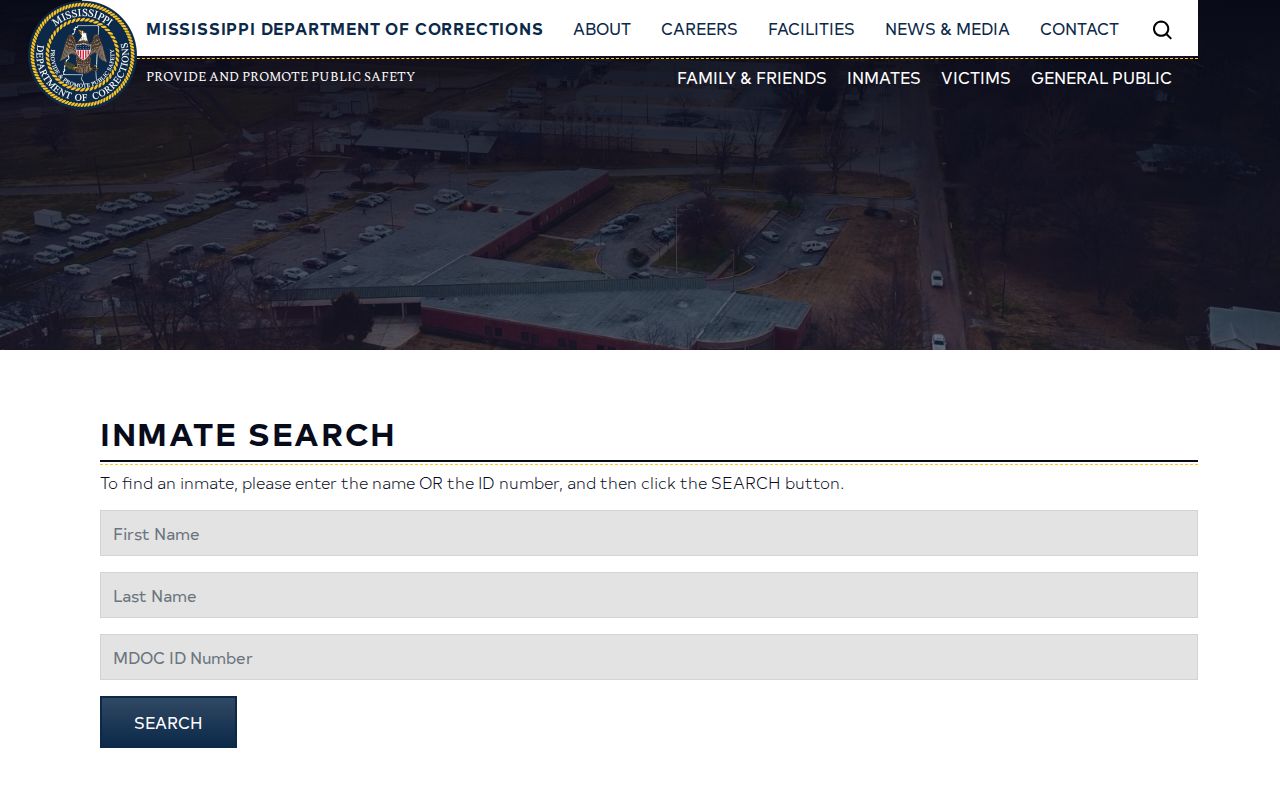
This screen belongs to the state system. It cannot verify a county-only bond release for a person who never entered MDOC custody.
Hancock Release or Custody Transfer
The Hancock County Public Safety Complex can hold legally different groups in one building. The sheriff's visitation information identifies sections for MDOC prisoners, while federal inspection material documents an ICE contract population. A person can disappear from the same local roster because they went into the community, returned to MDOC authority, or moved under ICE control.
This mixed-custody detail changes the verification question. Ask HCSO whether the event was a physical community release or a transfer. If transferred, request the receiving agency. Then switch to the matching official locator. The MDOC search covers state correctional status. ICE's Online Detainee Locator covers eligible current civil immigration custody records. Neither replaces the county transaction that shows who received the person.
Leaving the Hancock roster and leaving legal custody are not the same event when MDOC, ICE, or another jail receives the person.
Confirm Hancock ICE Release Transfers
The Hancock complex has a documented ICE Enforcement and Removal Operations detention agreement and has held immigration detainees awaiting transport. Federal inspection and audit records describe that role, but they do not turn each roster disappearance into an immigration event. HCSO's own transaction should first identify ICE or another federal agency as the recipient. Without that affirmative destination, an empty county search remains unresolved.
After an ICE transfer is confirmed, search the Online Detainee Locator by A-number and country of birth, or by name, date of birth, and country of birth. ODLS is a current civil immigration custody locator. It is not a criminal release archive, and recent moves or some categories may not appear at once. If the locator does not resolve the transfer, use the ICE contact route associated with the case rather than switching to BOP, which serves federal prison records.
The distinction protects the meaning of the Hancock release record. A county release date can show when HCSO stopped holding someone while a second agency's record shows that custody continued. Ask for both when the destination is disputed.
Verify Hancock Release Notifications
Mississippi VINELink supports a person-specific custody search and notifications from participating agencies. Choose Mississippi, search by the correct name or offender ID, compare identifiers, and open the detail. A released or out-of-custody event should be recorded with its date and source agency. Call that agency if the legal type, exact time, or destination matters.
VINE is not a countywide list of everyone released, and an alert is not a certified record. Data can lag or change after an agency correction. For federal prison, use the BOP Inmate Locator. BOP may display a release date and released or not-in-BOP-custody context, mainly for federal prisoners from 1982 onward. A federal docket can explain the judgment, and supervision may continue after BOP custody ends.
ICE ODLS is for civil immigration detention. The U.S. Marshals Service does not offer a matching public historical release archive. These channels answer different questions and should not be combined into one generic federal search.
Compare Hancock Release Search Paths
Choose the source by custody type and by the fact that needs proof. A roster can answer whether someone appears in current county custody. It cannot supply a final court disposition, a state discharge, or a federal release by itself.
| Question | Primary source | What it cannot prove alone |
|---|---|---|
| Still in Hancock jail? | HCSO JailTracker and jail confirmation | Why an absent person left |
| Released or transferred from Hancock? | HCSO release transaction | Final court outcome |
| State custody or ERS? | MDOC detail and MDOC Records | County-only release |
| Why did the case change? | Justice, municipal, or circuit docket | Exact gate time |
| Federal prison release? | BOP locator and federal docket | Other agency custody |
| Immigration detention? | ICE ODLS | Criminal case disposition |
Can a person be outside prison and still under MDOC? Yes. Earned Release Supervision and parole involve physical release with state jurisdiction or supervision continuing. Final discharge is a later and different status.
Hancock County Release Facilities
The local and serving systems below have distinct release paths. The first is Hancock County's main jail. The municipal agencies may process an arrest before release or delivery to the county complex. MDOC, federal prison, community corrections, and ICE pages explain the system that serves a Hancock case even when no matching institution was confirmed inside the county.
- Hancock County Public Safety Complex / Hancock County Adult Detention Center: county, housed MDOC, and documented contract immigration custody require an exact destination check.
- Bay St. Louis Police Department: verify release at the agency or delivery to HCSO, then check the correct municipal or county court.
- Waveland Police Department: identify which agency made the custody decision before requesting the record.
- Mississippi Department of Corrections institutions and community-corrections system: use MDOC for state sentences, ERS, parole, and discharge records.
- MDOC Community Corrections, Region serving the Gulf Coast / Hancock County: the Waveland office is the local supervision channel.
- Federal Bureau of Prisons system: use the BOP locator for federal custody and release dates.
- U.S. Immigration and Customs Enforcement detention network: use ODLS after a documented immigration transfer.